
Eventhough vs even though is a common confusion in English writing, but the correct form is “even though” written as two separate words. The word “eventhough” is not grammatically correct and is considered a spelling mistake in standard English. “Even though” is a conjunction used to introduce contrast between two ideas, especially when one part of the sentence shows an unexpected result. Many people write “eventhough” because it sounds like one word in fast speech, but in proper writing it must always be written as two words. Understanding this difference is important for improving grammar and writing accuracy.
The difference between eventhough vs even though becomes clearer when you understand their usage. “Even though” is widely used in both spoken and written English to connect contrasting ideas, similar to “although” and “though.” On the other hand, “eventhough” has no meaning in English and should never be used in formal writing, academic content, or professional communication. Learning the correct usage helps you avoid common grammar mistakes and improves the clarity of your writing.
What Does Even Though Mean
Even though is a conjunction used to show contrast between two ideas in a sentence. It is used when one part of the sentence is surprising or different from what you expect. In simple words, even though means “despite the fact that,” and it helps connect two ideas that do not match or are opposite in meaning. For example, when you say “Even though it was raining, we went outside,” the sentence shows a contrast between rain and going outside, while in “Even though he was tired, he finished his work,” the contrast is between being tired and still completing the task, making the phrase very useful for expressing unexpected results clearly.
Is Eventhough a Word
Eventhough is not a correct word in English and should not be used in any form of writing. It is simply a common spelling mistake that occurs when people combine “even” and “though” into one word, but in standard English grammar these two words must always remain separate. This mistake often appears in informal writing, especially in texting or fast typing, but it is not accepted in dictionaries or professional communication, and using it can make your writing look incorrect and less professional.
Why Do People Write Eventhough
Many people write “eventhough” because of pronunciation and typing habits, as when spoken quickly “even though” sounds like a single word, which leads to confusion among learners and even native speakers. Another reason is typing speed on mobile devices, where users often combine words without thinking about grammar, and informal communication on social media also encourages such mistakes, but in proper English writing “even though” must always be written as two separate words.
Even Though vs Though vs Although
Even though, though, and although all show contrast, but they differ slightly in usage and emphasis, where even though is used to give stronger emphasis, although is slightly more formal and commonly used in writing, and though is more informal and often used in casual conversation. For example, “Even though it was cold, she went out” gives strong emphasis, “Although it was cold, she went out” sounds more formal, and “It was cold, though she went out” is more conversational, showing how these words can be used differently depending on context.
How to Use Even Though in Sentences
Even though is used to connect two clauses where one contrasts with the other, usually appearing at the beginning of a sentence followed by a subject and verb, and then the main clause. For example, “Even though he was late, he attended the meeting” shows that despite being late he still attended, while “Even though she studied hard, she did not pass the exam” shows an unexpected result, and this structure helps create clear, meaningful, and grammatically correct sentences.
Examples of Even Though in Sentences
Even though is commonly used in everyday English to show contrast in a natural way, such as “Even though it was expensive, I bought it,” which shows a difference between cost and decision, or “Even though she was sick, she went to school,” which shows an unexpected action, while “Even though he apologized, she remained upset” highlights emotional contrast and “Even though it was late, they continued working” shows persistence despite difficulty.
Common Mistakes with Even Though
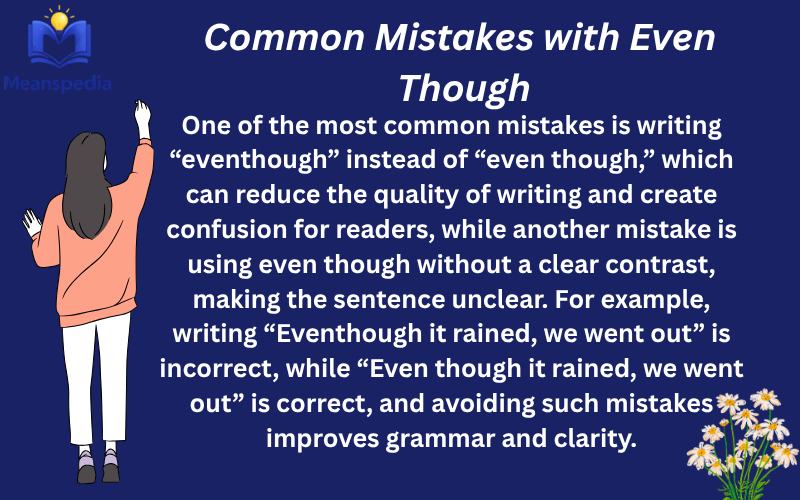
One of the most common mistakes is writing “eventhough” instead of “even though,” which can reduce the quality of writing and create confusion for readers, while another mistake is using even though without a clear contrast, making the sentence unclear. For example, writing “Eventhough it rained, we went out” is incorrect, while “Even though it rained, we went out” is correct, and avoiding such mistakes improves grammar and clarity.
When to Use Even Though
Even though should be used when you want to show contrast between two ideas, especially when the result is unexpected or surprising, such as when someone achieves something despite difficulty or continues something despite challenges, and using this phrase correctly helps add depth and clarity to your writing.
Even Though in Formal and Informal English
Even though is suitable for both formal and informal English, as it is commonly used in academic writing, essays, and reports to present ideas clearly, while also being widely used in conversations, chats, and social media to make communication more natural and expressive, making it a very flexible and useful part of English grammar.
Related Post: Due To or Do To Difference, Meaning, and Correct Usage
Even Though in Spoken English
In spoken English, even though is often pronounced quickly, which makes it sound like a single word and leads many people to write it incorrectly as “eventhough,” but pronunciation does not change spelling rules, and in writing it must always remain as two separate words.
Advantages of Using Even Though
Using even though correctly improves sentence clarity, helps express contrast effectively, and allows writers to connect ideas smoothly, making their writing more engaging and easier to understand in both spoken and written communication.
Disadvantages of Incorrect Usage
Using incorrect forms like “eventhough” can create grammar errors, reduce writing quality, and make your content appear less professional, especially in academic or formal contexts, which is why it is important to use the correct form.
Tips to Remember the Difference
To avoid mistakes, always remember that even though is written as two words, never combine them into one, think of it as “even + though,” and always check your writing carefully before publishing to ensure correctness.
Similar Phrases to Even Though
There are several phrases similar to even though that also show contrast, including although, though, despite, and in spite of, and while they have similar meanings, they differ slightly in structure and usage, allowing you to create more variety in your writing.
“If you would like to see more articles like this, here they are.”
- Due To or Do To Difference, Meaning, and Correct Usage
- Annual vs Yearl What’s the Difference and When to Use Each
- Assume vs Presume Meaning, Differences, and How to Use
- Gases or Gasses What Is the Correct Spelling and Meaning?
- Adapter vs Adaptor Meaning, Difference & Usage Explained
FAQs
What is the difference between eventhough vs even though
The correct form is “even though,” while “eventhough” is incorrect
Is eventhough a real word
No, it is a spelling mistake
What does even though mean
It means “despite the fact that”
Can I use even though in formal writing
Yes, it is correct in both formal and informal writing
Why do people write eventhough
Because of pronunciation and typing habits
Is even though one word
No, it is always two words
Related Post: Annual vs Yearl What’s the Difference and When to Use Each
Conclusion
The difference between eventhough vs even though is simple but very important in English grammar, as even though is the correct form used to show contrast between two ideas, while eventhough is just a common spelling mistake that should always be avoided in proper writing. Using even though correctly improves clarity, makes your sentences more meaningful, and helps you communicate more effectively.
By understanding how and when to use even though, you can avoid common grammar mistakes and improve your overall writing skills, whether you are writing essays, sending messages, or communicating in daily life, and using correct grammar will always leave a better impression and make your English more professional.