
Correct or correctly both relate to accuracy, but they are used differently in sentences based on grammar rules. “Correct” is an adjective, which means it describes a noun, while “correctly” is an adverb, which describes a verb, action, or process. Understanding the difference between correct and correctly is important because using the wrong form can make a sentence grammatically incorrect or unclear in meaning.
In simple terms, “correct” is used when you are describing something as accurate or right, while “correctly” is used when you are describing how something is done. This small difference plays a big role in English grammar, especially in writing, speaking, and professional communication. In this article, you will learn the full meaning of correct and correctly, their differences, how to use them in sentences, examples, common mistakes, and practical tips to use them properly in daily communication.
What Does Correct Mean?
The word correct is an adjective that is used to describe something that is accurate, true, or free from errors. It is commonly used in everyday communication to show that something is right or acceptable according to rules, facts, or standards. When you use the word correct, you are usually talking about a noun, such as an answer, method, idea, or statement.
Correct is widely used in academic, professional, and casual contexts because it helps people confirm whether something is right or wrong. It also plays an important role in decision-making, problem-solving, and communication. When someone says something is correct, they are expressing agreement with accuracy or truth.
Meaning of Correct
- Right
- Accurate
- Without mistakes
- Proper
Example Sentences
- This answer is correct.
- You gave the correct information.
- That is the correct way to solve the problem.
- His decision was correct.
What Does Correctly Mean?
The word correctly is an adverb, and it is used to describe how an action is performed. It explains the manner in which something happens, showing that the action was done in the right or proper way. Unlike “correct,” which describes nouns, “correctly” focuses on verbs and actions.
Correctly is often used in situations where performance, behavior, or execution matters. For example, when solving a problem, completing a task, or following instructions, correctly shows that the action was done without mistakes. This makes it an important word in both spoken and written English.
Meaning of Correctly
- In the right way
- Without mistakes
- Properly
- Accurately
Example Sentences
- You answered the question correctly.
- She completed the task correctly.
- He pronounced the word correctly.
- They followed the instructions correctly.
Difference Between Correct and Correctly
The main difference between correct and correctly is based on their grammatical function. One is an adjective, and the other is an adverb, which means they are used in different parts of a sentence.
| Word | Type | Usage |
| Correct | Adjective | Describes a noun |
| Correctly | Adverb | Describes a verb |
Simple Explanation
- Use correct when describing something
- Use correctly when describing an action
Understanding this difference helps you form grammatically accurate sentences.
When to Use Correct
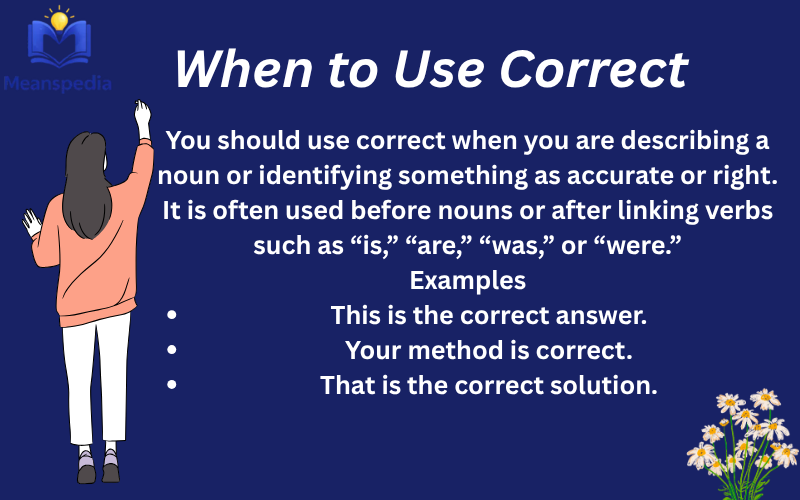
You should use correct when you are describing a noun or identifying something as accurate or right. It is often used before nouns or after linking verbs such as “is,” “are,” “was,” or “were.”
Examples
- This is the correct answer.
- Your method is correct.
- That is the correct solution.
When to Use Correctly
You should use correctly when describing how an action is performed. It is used with verbs to explain that something was done properly.
Examples
- He solved the problem correctly.
- She wrote the answer correctly.
- They completed the work correctly.
Related Post: Resetted or Reset Which Is Correct and When to Use It?
Common Mistakes with Correct and Correctly
Many learners confuse these words because they look similar, but their usage is different.
❌ You did it correct
✔ You did it correctly
❌ This is correctly answer
✔ This is correct answer
❌ She speaks English correct
✔ She speaks English correctly
Avoiding these mistakes improves your grammar accuracy.
Correct vs Correctly in Formal and Informal Communication
Understanding the difference between correct and correctly becomes even more important when you move between informal and formal communication. In casual conversations, people sometimes ignore grammar rules and use “correct” instead of “correctly,” but this habit should be avoided in professional or academic writing. For example, writing “You did it correct” in a message may be acceptable in informal chatting, but it is not suitable in emails, reports, or official documents.
In formal communication, grammar plays a key role in clarity and professionalism. Using the correct form helps you communicate your ideas clearly and shows that you have a strong understanding of English. This is especially important for students, professionals, and anyone who wants to improve their writing and speaking skills. Proper usage of correct and correctly can make your communication more effective and reliable.
Correct vs Correctly in Spoken English
In spoken English, people sometimes ignore strict grammar rules because conversations are fast and informal. However, using the correct form still makes your speech more accurate and professional. Saying “You answered correctly” sounds more natural and polished compared to “You answered correct,” which may sound incomplete or incorrect.
Using proper grammar in spoken English also improves confidence and clarity. When you speak correctly, people understand you better, and your communication becomes more effective. This is particularly important in interviews, presentations, and formal discussions where clear communication matters.
How to Practice Using Correct and Correctly
Learning the difference between correct and correctly requires practice. One effective method is to write sentences and identify whether you are describing a noun or an action. If you are describing something, use “correct,” and if you are describing how something is done, use “correctly.”
You can also improve by reading books, articles, and online content where these words are used properly. Listening to English conversations and practicing speaking can also help reinforce your understanding. Over time, you will naturally start using these words correctly without thinking too much.
Common Grammar Rules Related to Correct and Correctly
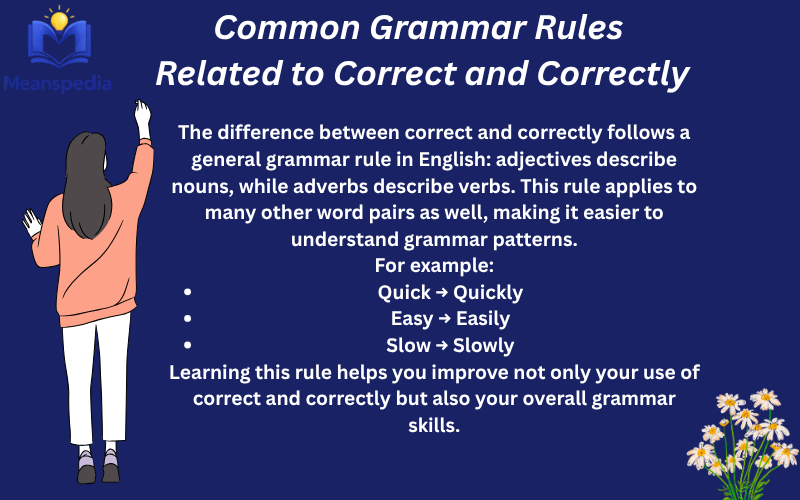
The difference between correct and correctly follows a general grammar rule in English: adjectives describe nouns, while adverbs describe verbs. This rule applies to many other word pairs as well, making it easier to understand grammar patterns.
For example:
- Quick → Quickly
- Easy → Easily
- Slow → Slowly
Learning this rule helps you improve not only your use of correct and correctly but also your overall grammar skills.
Importance of Using Correct and Correctly in Exams and Writing
Using correct grammar is very important in exams, essays, and professional writing. Grammar mistakes can reduce your marks in exams and affect the quality of your writing. For example, writing “He solved the problem correct” would be marked wrong, while “He solved the problem correctly” is the correct answer.
In professional communication, proper grammar creates a positive impression. It shows that you are careful, knowledgeable, and serious about your work. By using correct and correctly properly, you can improve your writing skills and achieve better results in both academic and professional environments.
Similar Words Like Correct and Correctly
| Word | Type | Example |
| Quick | Adjective | A quick response |
| Quickly | Adverb | Respond quickly |
| Easy | Adjective | Easy task |
| Easily | Adverb | Solve easily |
“If you would like to see more articles like this, here they are.”
- Resetted or Reset Which Is Correct and When to Use It?
- Northeast vs North East Difference, Meaning, and Usage
- Segway vs Segue Meaning, Difference, and How to Use Them
- Persue or Pursue Correct Spelling, Meaning and Usage
- Eventhough vs Even Though Meaning, Difference, and Usage
FAQs
What is the difference between correct and correctly?
Correct is an adjective, while correctly is an adverb.
When should I use correct?
Use correct when describing a noun.
When should I use correctly?
Use correctly when describing an action.
Is “you did it correct” wrong?
Yes, it should be “you did it correctly.”
Can correct be used as an adverb?
No, correct is mainly an adjective.
Why do people confuse correct and correctly?
Because they look similar but have different grammar roles.
Is correctly always used with verbs?
Yes, it describes how an action is done.
Is this important for English learning?
Yes, it improves grammar and communication skills.
Related Post: Northeast vs North East Difference, Meaning, and Usage
Conclusion
The difference between correct and correctly is simple but very important in English grammar. Correct is used as an adjective to describe nouns, while correctly is used as an adverb to describe actions. Understanding this difference helps you avoid common mistakes and improves your writing and speaking skills. By learning when to use each word, you can make your communication more accurate and professional.
In everyday communication, using correct grammar builds confidence and clarity. Whether you are writing emails, preparing for exams, or speaking in conversations, knowing how to use correct and correctly properly will help you express your ideas clearly. With regular practice and attention to grammar rules, you can easily master their usage and improve your overall English skills.