
Year old vs years old is a common grammar confusion in English, especially when describing age. The correct usage depends on how the phrase is used in a sentence. “Year old” is typically used as a compound adjective before a noun, while “years old” is used after a verb to describe someone’s age. Understanding this difference is important for writing clear and grammatically correct sentences in both formal and informal English.
Many learners and even native speakers get confused between “year old” and “years old” because both refer to age but are used in different grammatical structures. The key difference lies in sentence position and hyphen usage. In this article, you will learn the exact difference between year old vs years old, how to use each correctly, grammar rules, examples, common mistakes, and tips to avoid errors in everyday writing and speaking.
Understanding the difference between year old vs years old becomes even more important when writing longer sentences or professional content, where small grammar mistakes can affect the overall clarity of your message. Many writers accidentally mix both forms in the same sentence, which creates confusion for readers and reduces the quality of writing. For example, writing “He is a 10 years old boy” is incorrect because it combines both structures incorrectly. The correct sentence should be either “He is 10 years old” or “He is a 10-year-old boy.” This shows that choosing the correct structure depends entirely on how the sentence is formed, not just the meaning. By mastering this rule, writers can improve sentence flow, readability, and grammatical accuracy in both academic and everyday writing.
Another important aspect of using year old vs years old correctly is consistency, especially when writing essays, blogs, or professional documents. Inconsistent usage can make content look unpolished and less reliable to readers. For example, switching between “year-old” and “years old” incorrectly within the same paragraph can confuse the audience and weaken your writing style. This is why many style guides and grammar experts emphasize learning this rule early. Once you understand when to use each form, it becomes natural and automatic in writing. Over time, this improves not only grammar but also confidence in English communication, making your content more professional, clear, and easy to understand for a global audience.
What Does “Year Old” Mean?
“Year old” is used as a compound adjective that describes the age of a person, animal, or object when placed before a noun. It is usually written with hyphens as “year-old.” This form directly modifies the noun and gives specific information about age in a compact and grammatically correct way, which is why it is widely used in both formal and informal English writing.
For example, in the phrase “a 10-year-old boy,” the term “year-old” functions as an adjective that describes the noun “boy.” This structure is very common in English because it keeps sentences concise and clear without needing additional explanation. Writers prefer this format when they want to present age information quickly and efficiently.
Examples
- A 10-year-old boy
- A 5-year-old dog
- A 100-year-old building
Key Points
- Always hyphenated
- Used before a noun
- Uses singular “year” even for plural numbers
What Does “Years Old” Mean?
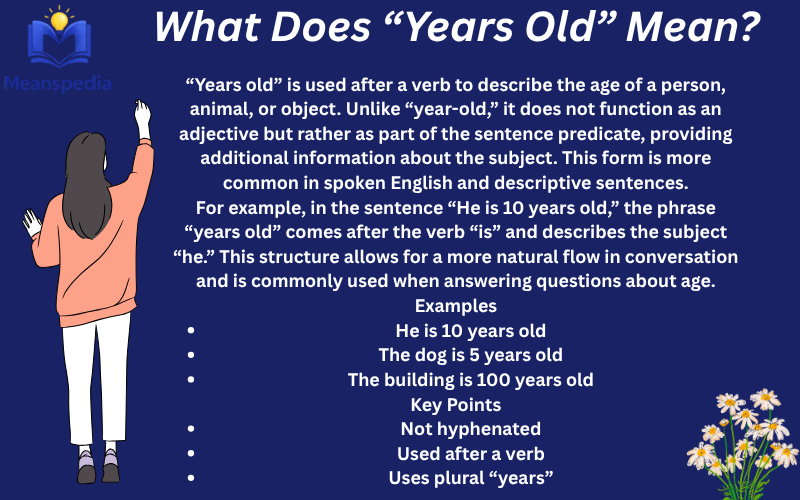
“Years old” is used after a verb to describe the age of a person, animal, or object. Unlike “year-old,” it does not function as an adjective but rather as part of the sentence predicate, providing additional information about the subject. This form is more common in spoken English and descriptive sentences.
For example, in the sentence “He is 10 years old,” the phrase “years old” comes after the verb “is” and describes the subject “he.” This structure allows for a more natural flow in conversation and is commonly used when answering questions about age.
Examples
- He is 10 years old
- The dog is 5 years old
- The building is 100 years old
Key Points
- Not hyphenated
- Used after a verb
- Uses plural “years”
Main Difference Between Year Old vs Years Old
The main difference between year old vs years old lies in grammar, sentence structure, and usage. While both phrases refer to age, they are used in completely different ways, which is why understanding their correct usage is essential for clear communication.
| Feature | Year Old | Years Old |
| Usage | Before noun | After verb |
| Form | Hyphenated | Not hyphenated |
| Grammar | Adjective | Descriptive phrase |
| Example | A 10-year-old boy | He is 10 years old |
Grammar Rules for Year Old vs Years Old
To use these terms correctly, it is important to follow basic grammar rules that define their structure and placement in a sentence.
Rule 1: Use “Year-Old” Before a Noun
When describing a noun, use “year-old” with hyphens.
Example:
- A 7-year-old child
- A 20-year-old student
Rule 2: Use “Years Old” After a Verb
When stating age, use “years old.”
Example:
- She is 7 years old
- They are 20 years old
Rule 3: Use Singular “Year” in Compound Form
Even if the number is more than one, use “year” in compound adjectives.
Correct:
- A 15-year-old boy
Incorrect:
- A 15-years-old boy ❌
Related Post: Ourselves or Ourself What’s the Difference and Correct Usage
Why “Year Old” Uses Singular Form
One of the most confusing aspects of this topic is why “year” remains singular in “year-old” even when referring to multiple years. The reason lies in grammar rules for compound adjectives, where the noun is treated as a single descriptive unit rather than a countable item.
In this structure, “year” acts as part of an adjective phrase and therefore does not change to plural form. This is a standard rule in English grammar that applies to many similar constructions.
Examples of Year Old vs Years Old
Year Old Examples
- A 3-year-old baby
- A 25-year-old man
- A 50-year-old building
Years Old Examples
- The baby is 3 years old
- The man is 25 years old
- The building is 50 years old
Common Mistakes to Avoid
Many people make simple mistakes when using these phrases, especially when combining both structures incorrectly.
Incorrect:
- A 10 years old boy ❌
Correct:
- A 10-year-old boy ✅
Incorrect:
- He is 10 year old ❌
Correct:
- He is 10 years old ✅
Why This Grammar Rule Matters
Understanding the difference between year old vs years old is important because it improves clarity, accuracy, and professionalism in writing. Small grammar mistakes can confuse readers and reduce the quality of your content.
Tips to Remember the Difference
- Before noun → year-old
- After verb → years old
- Hyphen = adjective
- No hyphen = descriptive phrase
“If you would like to see more articles like this, here they are.”
- Ourselves or Ourself What’s the Difference and Correct Usage
- Correct Or Correctly Meaning, Difference, and Usage Explained
- Resetted or Reset Which Is Correct and When to Use It?
- Northeast vs North East Difference, Meaning, and Usage
- Segway vs Segue Meaning, Difference, and How to Use Them
FAQs
What is the difference between year old and years old?
“Year old” is used before a noun as a compound adjective, while “years old” is used after a verb to describe age in a sentence.
Is it 10 year old or 10 years old?
Both are correct depending on sentence structure. Use “10-year-old” before a noun and “10 years old” after a verb.
Why is year old singular?
“Year” stays singular in “year-old” because it functions as part of a compound adjective, and adjectives do not take plural forms.
Do we always use hyphens in year-old?
Yes, when “year-old” is used before a noun, it should always be hyphenated to follow correct grammar rules.
Is “years-old” correct?
No, “years-old” is incorrect. The correct forms are “year-old” (before a noun) and “years old” (after a verb).
Can I use year old without a hyphen?
No, when used before a noun, “year-old” must include a hyphen to be grammatically correct.
Which is correct: 5-year-old or 5 years old?
Both are correct depending on usage. Use “5-year-old” before a noun and “5 years old” after a verb.
Is this grammar rule important?
Yes, it is important for writing clear, correct, and professional English, especially in formal and academic contexts.
Related Post: Correct Or Correctly Meaning, Difference, and Usage Explained
Conclusion
The difference between year old vs years old is simple but essential for correct English grammar. “Year-old” is used before a noun as a compound adjective, while “years old” is used after a verb to describe age. Learning this rule helps avoid common mistakes and improves clarity in both writing and speaking.
By practicing these forms regularly, you can easily remember when to use each one correctly. Mastering small grammar differences like this can significantly improve your overall communication skills and make your English more professional and effective.