

The difference between “due to” and “do to” is simple: “due to” is correct and widely used, while “do to” is usually incorrect in most contexts. “Due to” means caused by or because of something, and it is used in sentences to explain reasons. On the other hand, “do to” is rarely used and is often a mistake people make when they confuse spelling or grammar in English writing.
Understanding “due to or do to” is important because many people use the wrong form in writing, especially in texting, emails, and online content. While “due to” is a proper phrase used in formal and informal English, “do to” only appears in very specific situations related to the verb “do.” In this article, you will learn the full difference between due to and do to, their meanings, usage rules, examples, and how to avoid common mistakes in everyday communication.
What Does “Due To” Mean?
“Due to” is a common English phrase that means because of or caused by something. It is used to explain the reason behind a situation or event.
Simple Explanation
“Due to” = because of / caused by
It is often used in both formal and informal writing, including essays, emails, and conversations.
Example Sentences
- The match was canceled due to rain
- The flight was delayed due to bad weather
- The project failed due to poor planning
In all these examples, “due to” explains the reason behind something.
What Does “Do To” Mean?
“Do to” is not commonly used as a phrase like “due to.” Instead, it is made up of two separate words: “do” (a verb) and “to” (a preposition).
Meaning
“Do to” means performing an action toward someone or something, but it is rarely used in normal sentences.
Example
- What did you do to him?
- What can this machine do to improve efficiency?
Here, “do” is a verb, and “to” connects it to the object. This is very different from “due to.”
Key Difference Between Due To and Do To
Understanding the difference between due to and do to is important for correct grammar.
| Phrase | Meaning | Usage |
| Due to | Because of | Explains reason |
| Do to | Verb + preposition | Shows action |
Simple Rule
- Use due to for reasons
- Use do to only when “do” is a verb
When to Use “Due To”
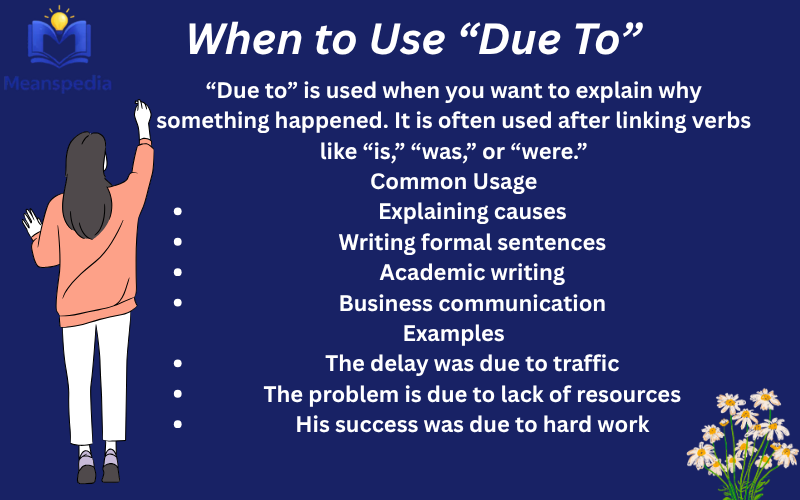
“Due to” is used when you want to explain why something happened. It is often used after linking verbs like “is,” “was,” or “were.”
Common Usage
- Explaining causes
- Writing formal sentences
- Academic writing
- Business communication
Examples
- The delay was due to traffic
- The problem is due to lack of resources
- His success was due to hard work
When to Use “Do To”
“Do to” is used when “do” is acting as a verb and “to” is connecting it to something.
Common Usage
- Asking questions
- Describing actions
- Talking about effects
Examples
- What did you do to fix the issue?
- What can we do to improve performance?
- What did he do to make you upset?
Common Mistakes with Due To and Do To
Many people confuse “due to” and “do to” because they sound similar.
Common Errors
❌ The meeting was canceled do to rain
✅ The meeting was canceled due to rain
❌ The delay happened do to traffic
✅ The delay happened due to traffic
Tip
If the sentence explains a reason, always use due to.
Why People Confuse Due To and Do To
There are several reasons why people make this mistake.
Reasons
- Similar pronunciation
- Fast typing in chats
- Lack of grammar knowledge
- Autocorrect errors
- Informal writing habits
Understanding the correct usage helps avoid these mistakes.
Related Post: Annual vs Yearl What’s the Difference and When to Use Each
Due To in Formal vs Informal Writing
“Due to” is used in both formal and informal writing, but it is especially important in professional contexts.
Formal Usage
- Business emails
- Reports
- Academic writing
Informal Usage
- Text messages
- Social media
- Casual conversations
Examples of Due To and Do To in Sentences
| Sentence | Correct Usage |
| The event was canceled due to rain | Correct |
| What did you do to fix it? | Correct |
| The problem happened do to error | Incorrect |
| What can we do to solve this? | Correct |
Tips to Remember the Difference
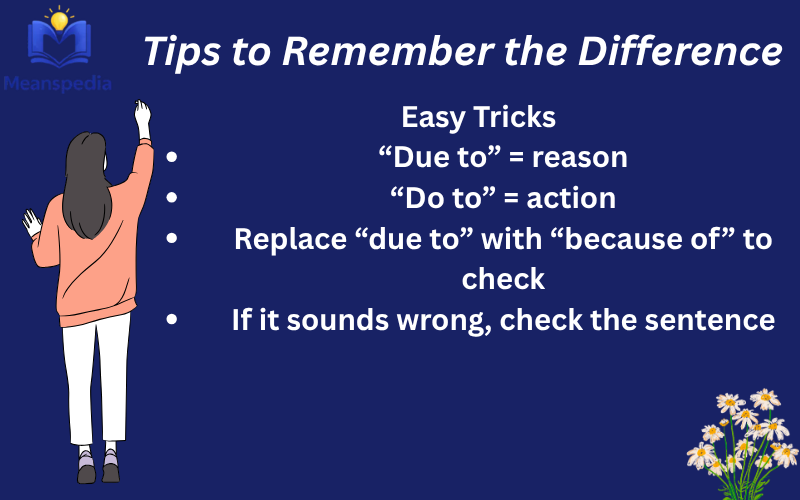
Easy Tricks
- “Due to” = reason
- “Do to” = action
- Replace “due to” with “because of” to check
- If it sounds wrong, check the sentence
Similar Confusing Words
English has many confusing word pairs.
| Words | Difference |
| Your / You’re | Possession vs contraction |
| Their / There | Ownership vs place |
| Affect / Effect | Verb vs noun |
Learning these helps improve writing accuracy.
Why Correct Usage Matters
Using the correct phrase improves communication and professionalism.
Benefits
- Better writing skills
- Clear communication
- Professional image
- Avoids confusion
“If you would like to see more articles like this, here they are.”
- Assume vs Presume Meaning, Differences, and How to Use
- Annual vs Yearl What’s the Difference and When to Use Each
- Gases or Gasses What Is the Correct Spelling and Meaning?
- Disfunction vs Dysfunction Meaning, Difference, and Usage
- Adapter vs Adaptor Meaning, Difference & Usage Explained
FAQs
What is the difference between due to and do to?
“Due to” means because of, while “do to” refers to an action.
Is do to ever correct?
Yes, but only when “do” is a verb in a sentence.
Which one is more common?
“Due to” is much more common.
Can I use due to in formal writing?
Yes, it is widely used in formal English.
Why do people confuse them?
Because they sound similar.
Is do to grammatically wrong?
Not always, but often used incorrectly.
How can I remember the difference?
Use “because of” instead of “due to” to check.
Can due to start a sentence?
Yes, but it should be used carefully.
Is due to informal?
No, it is both formal and informal.
Should I avoid do to?
Only use it when it is grammatically correct.
Related Post: Assume vs Presume Meaning, Differences, and How to Use
Conclusion
The difference between due to and do to is important for correct English usage. “Due to” is used to explain reasons and is commonly used in both formal and informal writing. On the other hand, “do to” is rarely used and only appears when “do” is a verb followed by “to.” Understanding this difference helps improve writing clarity and avoids common grammar mistakes.
By learning how to use due to correctly and recognizing when do to is appropriate, you can write more accurately and professionally. Whether you are writing emails, articles, or text messages, using the correct phrase ensures clear communication and better understanding. Mastering small grammar differences like this can greatly improve your overall English skills.