
Assume vs presume refers to the difference between two commonly confused English words that both relate to making a belief without full proof. The word assume means to think something is true without evidence, while presume means to believe something is true based on probability, prior knowledge, or reasonable evidence. Although both words are similar, they are used in slightly different contexts, and understanding this difference is important for correct communication.
In everyday English, many people use assume and presume interchangeably, but there is a subtle distinction between them that can affect the meaning of a sentence. Assume is often used when there is little or no evidence, while presume is used when there is some level of likelihood or logical reasoning behind the belief. In this article, you will learn the full meanings of assume and presume, their differences, examples, usage in sentences, and how to use them correctly in real-life communication.
What Does Assume Mean?
The word assume means to accept something as true without proof or evidence. It is often used when someone makes a guess or forms an opinion without having enough information.
When you assume something, you are not relying on facts but rather on your thoughts, feelings, or guesses. This makes the word assume less certain compared to presume.
Simple Explanation
| Word | Meaning | Usage |
| Assume | To believe something without proof | Guessing without evidence |
In many situations, assuming can lead to misunderstandings because it is not based on facts.
What Does Presume Mean?
The word presume means to believe something is true based on probability, logic, or some level of evidence. It suggests a stronger belief compared to assume.
When you presume something, you are making a conclusion based on reasonable information, patterns, or past experience.
Simple Explanation
| Word | Meaning | Usage |
| Presume | To believe something based on likelihood | Logical assumption |
Presuming is often more accurate than assuming because it involves some reasoning.
Key Difference Between Assume and Presume
The main difference between assume and presume is the level of certainty and evidence.
Comparison Table
| Feature | Assume | Presume |
| Evidence | No evidence | Some evidence |
| Certainty | Low | Higher |
| Basis | Guess | Logic or probability |
| Usage | Informal thinking | Reasoned belief |
In simple words, assume is guessing, while presume is a more informed belief.
How Assume Is Used in Sentences
The word assume is used in daily conversations when people make guesses without proof.
Examples
- I assume he is at home because his car is outside.
- She assumed the meeting was canceled.
- Don’t assume things without asking.
- I assumed you understood the instructions.
In these sentences, the speaker does not have confirmed information.
How Presume Is Used in Sentences
Presume is used when there is some logic or probability behind the belief.
Examples
- I presume he is at work because it is Monday morning.
- We presume the results will be announced tomorrow.
- The teacher presumed the student was absent due to illness.
- I presume you have completed your homework.
These sentences show a more logical conclusion.
When to Use Assume vs Presume
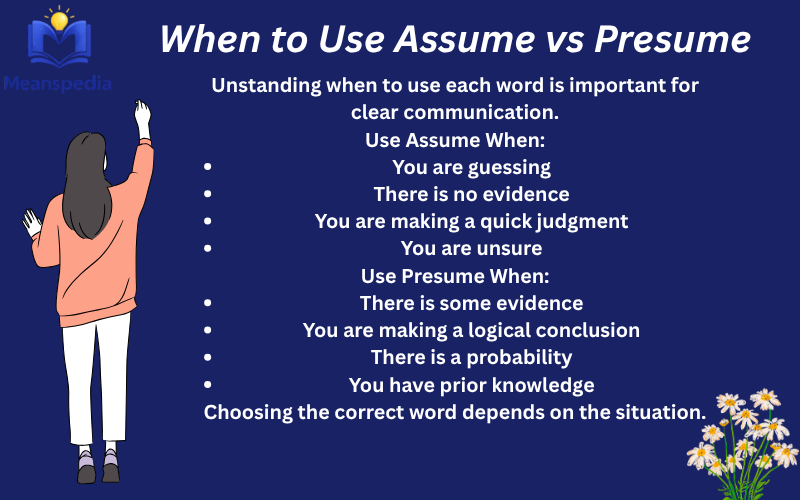
Understanding when to use each word is important for clear communication.
Use Assume When:
- You are guessing
- There is no evidence
- You are making a quick judgment
- You are unsure
Use Presume When:
- There is some evidence
- You are making a logical conclusion
- There is a probability
- You have prior knowledge
Choosing the correct word depends on the situation.
Why People Confuse Assume and Presume
Many people confuse these words because they have similar meanings and are often used in similar situations.
Reasons
- Both involve belief
- Both relate to thinking something is true
- Both are used in informal communication
- Lack of awareness of subtle difference
However, understanding their difference improves language accuracy.
Related Post: PP Meaning in Text What It Really Means and How to Use It
Assume vs Presume in Formal and Informal English
The usage of assume and presume can also depend on context.
Informal Usage
- Assume is more common
- Used in everyday conversation
Formal Usage
- Presume is more common
- Used in professional or academic writing
This makes presume slightly more formal than assume.
Common Mistakes to Avoid
People often misuse assume and presume in sentences.
Mistakes
- Using assume when evidence exists
- Using presume without logical basis
- Interchanging both words incorrectly
Correct Approach
- Use assume for guesses
- Use presume for logical conclusions
This helps avoid confusion.
Similar Words to Assume and Presume
There are other words with similar meanings.
| Word | Meaning |
| Guess | Form an opinion without proof |
| Suppose | Think something is possible |
| Imagine | Create an idea in mind |
| Believe | Accept something as true |
These words are related but have different nuances.
Advantages of Using the Correct Word
Using assume and presume correctly improves communication.
Benefits
- Clear meaning
- Better understanding
- Professional language
- Avoid misunderstandings
Correct usage makes your English more accurate and effective.
Assume vs Presume in Real-Life Situations
Understanding these words helps in real-life communication.
Examples
- In business communication
- In academic writing
- In daily conversation
- In professional emails
Using the right word improves clarity.
“If you would like to see more articles like this, here they are.”
- SF Meaning in Text: Full Guide, Uses and Real Examples
- SS Meaning in Text What It Really Means and How to Use It
- TTYL Meaning in Text What It Really Means and How to Use It
- SP Meaning in Text What It Really Means and How to Use It
- FML Meaning in Text What It Really Means and How to Use It
FAQs
What is the difference between assume and presume?
Assume means believing without proof, while presume means believing based on some evidence or probability.
Can assume and presume be used interchangeably?
Sometimes, but not always. They have slightly different meanings.
Which word is more formal?
Presume is more formal than assume.
Is assume always incorrect?
No, it is correct when used for guesses without evidence.
Is presume always based on facts?
Not always facts, but at least some logical reasoning.
Which is more certain: assume or presume?
Presume is more certain than assume.
Can I use assume in professional writing?
Yes, but presume is often preferred in formal contexts.
Why is it important to know the difference?
It helps improve clarity and accuracy in communication.
Related Post: GL Meaning in Text What It Means and How to Use It
Conclusion
The difference between assume and presume lies in the level of certainty and evidence behind a belief. Assume is used when there is little or no evidence, while presume is used when there is some logical reasoning or probability. Although both words are similar, using them correctly can improve the clarity of your communication and help avoid misunderstandings. Understanding this difference is especially important in professional and academic contexts where precise language matters.
In everyday communication, people often use assume and presume interchangeably, but knowing their correct usage gives you an advantage in expressing ideas clearly and accurately. By practicing these words in sentences and understanding their meanings, you can improve your English skills and communicate more effectively in both formal and informal situations.