

Many English learners feel confused when they see the words persue and pursue. These two spellings look very similar, and when spoken aloud, they sound almost the same. Because of this similarity, learners often believe that both spellings are correct and can be used interchangeably. This confusion is very common among beginners as well as intermediate English learners.
The problem becomes bigger because English spelling rules are not always logical. Many English words are not spelled the way they sound, and pursue is one of those words. Learners try to spell it by pronunciation and end up writing persue, which looks correct but is actually wrong.
In this detailed guide, you will fully understand the difference between persue or pursue. This article explains the correct spelling, meaning, grammar rules, verb forms, sentence usage, common mistakes, memory tricks, and practice examples in very simple English. By the end, you will be 100% confident and will never confuse persue and pursue again.
Persue or Pursue Which One Is Correct?
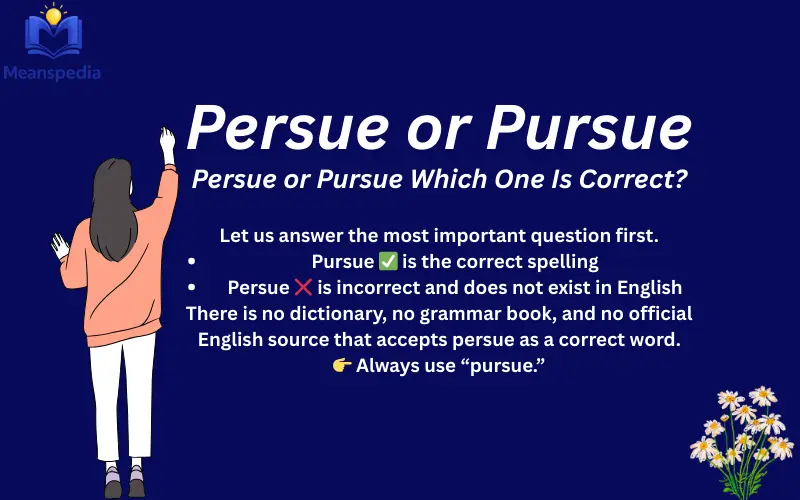
Let us answer the most important question first.
- Pursue ✅ is the correct spelling
- Persue ❌ is incorrect and does not exist in English
There is no dictionary, no grammar book, and no official English source that accepts persue as a correct word.
👉 Always use “pursue.”
See Also: Felt or Feel Simple Difference Explained With Easy Examples
Why Do Learners Confuse Persue or Pursue?
There are several reasons why learners make this mistake.
1. Similar Sound
Both persue and pursue sound almost the same when spoken.
2. English Spelling Is Confusing
English words often do not follow simple spelling rules.
3. Habit of Phonetic Spelling
Learners try to spell words the way they hear them.
4. Influence of Other Words
Words like peruse make learners think persue might be correct.
Meaning of the Word “Pursue”
The verb pursue has more than one meaning, but all meanings are related.
Basic Meaning of “Pursue”
Pursue means:
- to follow someone or something
- to try to achieve a goal
- to continue an activity
- to chase or run after
Simple Meanings of “Pursue” Explained
1. To Try to Achieve Something
When you work hard to reach a goal, you pursue it.
- She wants to pursue success.
- He decided to pursue his dreams.
2. To Follow or Chase
When you run after someone or something.
- The police pursued the thief.
- The dog pursued the cat.
3. To Continue an Activity
When you keep doing something seriously.
- He is pursuing higher education.
- She is pursuing a career in teaching.
Real-Life Examples of “Pursue”
- I want to pursue my passion.
- She plans to pursue medicine.
- They pursued happiness all their lives.
- He is pursuing his studies abroad.
Why “Persue” Is Wrong
The spelling persue is simply a spelling mistake.
- It is not listed in dictionaries
- It is not used in correct English
- It is marked wrong in exams
- It looks unprofessional in writing
👉 Persue is not a word.
Origin of the Word “Pursue” (Easy Explanation)
The word pursue comes from Old French and Latin words that mean to follow closely. Because of its origin, the spelling includes “sue” at the end.
That is why the spelling looks unusual:
p-u-r-s-u-e
Easy Tricks to Remember the Correct Spelling
Trick 1: Remember “Sue”
You sue your goals → purSUE
Trick 2: No Extra “E”
There is no “e” after r in pursue.
Trick 3: Think of “Use”
You use effort to pursue goals.
Verb Forms of “Pursue”
| Form | Example |
| pursue | I pursue my goals |
| pursues | He pursues success |
| pursued | She pursued education |
| pursuing | They are pursuing careers |
❌ Never write: persue, persued, persuing
Use of “Pursue” in Different Tenses
Present Simple
- He pursues his dreams.
- She pursues excellence.
Past Simple
- He pursued his goal.
- They pursued justice.
Present Continuous
- She is pursuing a degree.
- He is pursuing his passion.
Future Simple
- I will pursue my ambition.
- They will pursue success.
Common Collocations with “Pursue”
- pursue a career
- pursue a dream
- pursue education
- pursue happiness
- pursue success
- pursue justice
- pursue opportunities
Persue or Pursue in Formal English
In formal writing, only pursue is acceptable.
Correct
- I wish to pursue this opportunity.
Incorrect
- I wish to persue this opportunity.
Persue or Pursue in Exams
Using persue in exams:
- counts as a spelling mistake
- reduces marks
- shows weak vocabulary
Always use pursue to score better.
Persue or Pursue in Professional Writing
Emails, CVs, and cover letters must be error-free.
❌ I want to persue a career
✅ I want to pursue a career
Difference Between “Pursue” and “Peruse”
Many learners confuse these two words.
| Word | Meaning |
| pursue | to follow or try to achieve |
| peruse | to read carefully |
Examples:
- I will pursue my goal.
- I will peruse the document.
Common Mistakes Learners Make
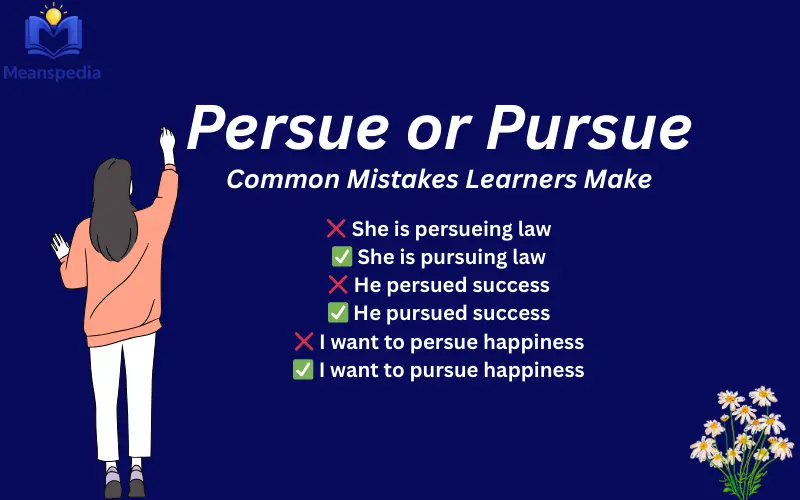
❌ She is persueing law
✅ She is pursuing law
❌ He persued success
✅ He pursued success
❌ I want to persue happiness
✅ I want to pursue happiness
Why Correct Spelling Is Important
Correct spelling:
- improves writing quality
- builds confidence
- avoids misunderstanding
- helps in exams and jobs
- looks professional
Simple Rule for Beginners
👉 Always use pursue
👉 Never use persue
This one rule solves the problem.
Practice Questions
Choose the correct word:
- He wants to ___ his dreams.
a) persue
b) pursue ✅ - She is ___ a medical degree.
a) persuing
b) pursuing ✅ - They ___ happiness together.
a) persued
b) pursued ✅
Why Learning Persue or Pursue Matters
Learning the difference between persue or pursue helps you:
- write correct English
- avoid common mistakes
- improve grammar
- sound fluent and confident
See Also: Taken vs Taking Easy Grammar Difference Explained Simply
Conclusion
The confusion between persue or pursue is very common, but the rule is simple. Pursue is the correct spelling and means to follow, chase, or try to achieve something. Persue is not a real English word and should never be used in writing or speaking.
Once you understand this difference and practice correct usage, your English writing will become clearer, more professional, and more confident. Remember one simple thing: always pursue your goals, never persue them.