
Many English learners feel confused when they see the words taken vs taking in sentences. Both words come from the same verb take, and both are very common in daily English. Because they look similar and share the same base verb, learners often believe they can use taken and taking in the same way. This confusion leads to many grammar mistakes in speaking, writing, and exams.
Another reason learners struggle with taken vs taking is that English verbs change their form depending on time, tense, and sentence structure. One form shows an action that is happening now, while the other shows an action that is already completed. If learners do not understand these differences clearly, they may choose the wrong form and make sentences sound incorrect.
This article explains taken vs taking in very simple English. Every concept is explained step by step using easy language, short sentences, and many examples. This guide covers meanings, grammar rules, tenses, passive voice, real-life usage, common mistakes, and practice exercises. By the end of this article, you will fully understand when to use taken, when to use taking, and why using the correct form is important for clear English.
Understanding the Base Verb “Take”
To understand taken and taking, we must first understand the base verb take.
The verb take has many meanings in English. Some common meanings are:
- to pick up something
- to receive something
- to consume food or medicine
- to carry something
- to choose something
- to accept something
Examples
- Please take this book.
- I take medicine every day.
- She takes the bus to work.
- He took my advice.
The verb take changes its form depending on how it is used in a sentence.
Verb Forms of “Take”
The verb take is an irregular verb. It does not follow the regular “-ed” pattern.
| Verb Form | Grammar Name | Example |
| take | base form | I take notes |
| taking | present participle / gerund | I am taking notes |
| taken | past participle | I have taken notes |
Each form has a different grammatical role.
See Also: Gluing vs Glueing Correct Spelling Explained Simply
What Does “Taking” Mean?
Taking is the present participle form of the verb take.
It is used when:
- the action is happening now
- the action is continuing
- the action is not finished
Basic Structure
be verb (am / is / are) + taking
Examples
- I am taking a shower.
- She is taking an English class.
- They are taking photos.
- He is taking his medicine.
In all these sentences, the action is happening at the moment of speaking.
When to Use “Taking”
Use taking when:
- the sentence is in continuous tense
- the action is ongoing
- the action is temporary
More Examples
- I am taking notes right now.
- She is taking a break.
- We are taking the train today.
- He is taking responsibility for the work.
“Taking” in Present Continuous Tense
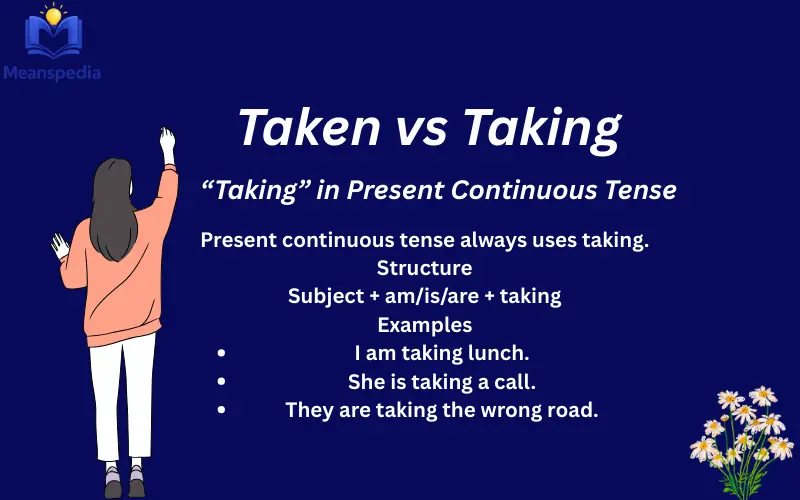
Present continuous tense always uses taking.
Structure
Subject + am/is/are + taking
Examples
- I am taking lunch.
- She is taking a call.
- They are taking the wrong road.
“Taking” as a Gerund (Verb Used as a Noun)
Sometimes taking is used as a noun. This is called a gerund.
Examples
- Taking care of health is important.
- Taking notes helps memory.
- Taking breaks improves focus.
Here, taking acts like a noun, not a verb.
What Does “Taken” Mean?
Taken is the past participle form of the verb take.
Important rule:
👉 Taken can never be used alone
It must always be used with a helping verb.
Helping Verbs Used With “Taken”
Common helping verbs include:
- has
- have
- had
- is
- was
- were
- be
- been
Structure
Helping verb + taken
Examples
- I have taken the keys.
- She has taken the test.
- The photo was taken yesterday.
- He had taken the medicine earlier.
When to Use “Taken”
Use taken when:
- the action is completed
- the action happened in the past
- the sentence uses a helping verb
More Examples
- I have taken your advice.
- She has taken my seat.
- They had taken the wrong bus.
Taken vs Taking: Main Difference
| Point | Taking | Taken |
| Verb type | Present participle | Past participle |
| Action | Ongoing | Completed |
| Used alone | Sometimes | Never |
| Needs helping verb | Usually | Always |
| Time focus | Present / continuing | Past / finished |
Easy Memory Trick
- Taking → action happening now
- Taken → action already finished
Taken vs Taking in Different Tenses
Present Continuous
- I am taking medicine.
Present Perfect
- I have taken medicine.
Past Perfect
- I had taken medicine before sleeping.
Future Continuous
- I will be taking the test tomorrow.
Future Perfect
- I will have taken the test by noon.
Taken vs Taking in Passive Voice
Passive voice always uses a past participle, so taken is used.
Examples
- The photo was taken by a professional.
- The exam was taken by all students.
- The medicine was taken on time.
❌ The photo was taking
✅ The photo was taken
Taken vs Taking in Questions
- Are you taking the course?
- Have you taken the course before?
The question form depends on tense.
Taken vs Taking in Negative Sentences
- I am not taking the offer.
- I have not taken the offer.
Common Real-Life Uses of “Taking”
Health
- I am taking antibiotics.
Education
- She is taking an online class.
Travel
- They are taking a taxi.
Work
- He is taking responsibility.
Common Real-Life Uses of “Taken”
Health
- I have taken my medicine.
Education
- She has taken the exam.
Travel
- They have taken the wrong flight.
Work
- He has taken charge of the project.
Common Mistakes Learners Make
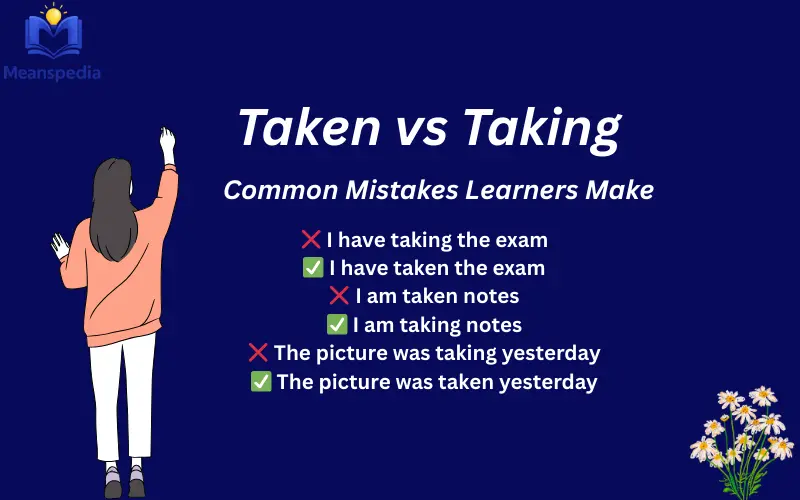
❌ I have taking the exam
✅ I have taken the exam
❌ I am taken notes
✅ I am taking notes
❌ The picture was taking yesterday
✅ The picture was taken yesterday
Taken vs Taking With Objects
- I am taking the bag.
- I have taken the bag.
The object stays the same, but the meaning changes.
Taken vs Taking in Everyday Conversation
- I am taking a break now.
- I have taken a break already.
Very Simple Rule for Beginners
- If the action is happening now → use taking
- If the action is finished → use taken
Practice Exercises
Choose the correct option:
- I am ___ notes. → taking
- I have ___ lunch. → taken
- She is ___ medicine. → taking
- The photo was ___ yesterday. → taken
- They are ___ the bus. → taking
- He has ___ responsibility. → taken
- We are ___ a short break. → taking
Why Learning Taken vs Taking Is Important
Understanding taken vs taking helps learners:
- speak correct English
- write clear sentences
- avoid grammar mistakes
- perform better in exams
- gain confidence
See Also: Mine As Well or Might As Well Which One Is Correct?
Conclusion
The difference between taken and taking depends on tense and sentence structure. Taking shows an action that is happening now or is ongoing, while taken shows an action that is completed and always needs a helping verb.
When learners understand these rules and practice with examples, using taken vs taking becomes easy and natural. Correct verb usage improves both spoken and written English and helps learners communicate clearly and confidently.