
Many English learners feel confused when they come across the words swap vs swop. These two words look almost identical, sound very similar, and carry the same basic meaning. Because of this, learners often believe that both words are used in the same way and can be freely replaced in any sentence.
The confusion becomes stronger because some dictionaries list swop as a correct word, while others focus mostly on swap. Learners also notice that swap is used everywhere in modern English, while swop appears rarely. This makes people unsure about which word is correct, which one sounds natural, and which one should be used in exams, writing, or professional communication.
This article explains swap vs swop in very simple and clear English. Every aspect is covered in detail, including meaning, grammar, history, regional usage, formal and informal English, real-life examples, mistakes learners make, and practical rules. By the end of this article, you will fully understand what swap means, what swop means, how they are different, and which word you should confidently use in modern English.
The Core Meaning Shared by Swap and Swop
Both swap and swop mean the same basic thing.
Shared Meaning
Both words mean:
- to exchange one thing for another
- to give something and receive something else
- to trade places, items, or ideas
Very Simple Examples
- Let’s swap seats.
- Let’s swop seats.
The meaning is the same: two people exchange seats.
So the difference between swap vs swop is not about meaning, but about usage, popularity, and correctness in modern English.
See Also: Persue or Pursue Correct Spelling and Easy Meaning
Understanding “Swap” in Detail
Meaning of “Swap”
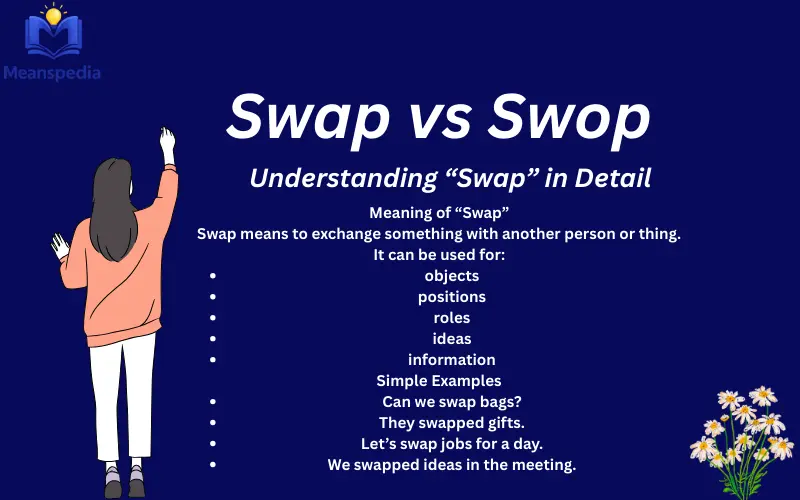
Swap means to exchange something with another person or thing.
It can be used for:
- objects
- positions
- roles
- ideas
- information
Simple Examples
- Can we swap bags?
- They swapped gifts.
- Let’s swap jobs for a day.
- We swapped ideas in the meeting.
Grammar Forms of “Swap”
Swap is a regular verb.
Verb Forms
| Form | Example |
| base | swap |
| past | swapped |
| present participle | swapping |
Examples in Sentences
- I swap books with my friend.
- I swapped seats yesterday.
- I am swapping shifts today.
“Swap” as a Noun
Swap is also commonly used as a noun.
Examples
- It was a fair swap.
- Let’s make a swap.
- The deal involved a swap of assets.
This noun usage is very common in modern English.
Everyday Situations Where “Swap” Is Used
Daily Life
- Let’s swap seats.
- Can we swap places?
School and Office
- Students swap books.
- Workers swap shifts.
Technology
- You can swap SIM cards.
- He swapped phones.
Business and Finance
- Companies swap shares.
- Currency swap agreements exist.
In all modern fields, swap is the normal and expected word.
Understanding “Swop” in Detail
Meaning of “Swop”
Swop has exactly the same meaning as swap:
- to exchange
- to trade one thing for another
Example
- They swopped places.
So again, the meaning is not the problem.
Is “Swop” Correct English?
Yes, swop is:
- a real English word
- listed in some dictionaries
But it is:
- rare
- mainly British
- less modern
- less natural today
In modern English, swop is not preferred.
Swap vs Swop: Regional Usage
British English
In British English:
- swap is very common
- swop exists but is rare
Examples:
- Let’s swap seats. (normal)
- Let’s swop seats. (old-fashioned but acceptable)
American English
In American English:
- swap is correct
- swop is almost never used
Example:
- Let’s swap phones.
❌ Let’s swop phones (sounds wrong in American English)
Swap vs Swop in Modern English
Modern English strongly prefers swap because:
- it is shorter
- it is easier to pronounce
- it is widely understood
- it is used globally
Swop feels:
- old
- uncommon
- unnecessary
Swap vs Swop in Writing and Exams
Writing
In essays, articles, and professional writing:
- swap is correct
- swop should be avoided
Exams
In grammar exams:
- swap is always safe
- swop may be marked wrong
So for learners, swap is the smart choice.
Past Tense: Swap vs Swop
Swap (Past Form)
- swap → swapped
Example:
- They swapped gifts.
Swop (Past Form)
- swop → swopped
Example:
- They swopped gifts. (British, rare)
Even the spelling swopped looks unusual to many learners.
Swap vs Swop as Nouns (Detailed)
Swap as a Noun
- a seat swap
- a job swap
- a currency swap
This usage is very common.
Swop as a Noun
- extremely rare
- mostly avoided
Swap vs Swop in Idioms and Fixed Phrases
Common Phrases With Swap
- swap seats
- swap places
- swap stories
- swap ideas
- swap roles
Phrases With Swop
Almost none in modern English.
This shows how dominant swap is.
Swap vs Swop in Technology and Science
Modern technical English always uses swap.
Examples:
- memory swap
- swap space
- file swap
- data swap
❌ Swop space (never used)
Swap vs Swop in Business and Law
Examples:
- asset swap
- debt swap
- currency swap
Again, swop is never used in professional fields.
Why “Swop” Is Slowly Disappearing
Swop is disappearing because:
- swap does the same job
- languages prefer simpler forms
- global English favors common words
This is normal language evolution.
Common Mistakes Learners Make
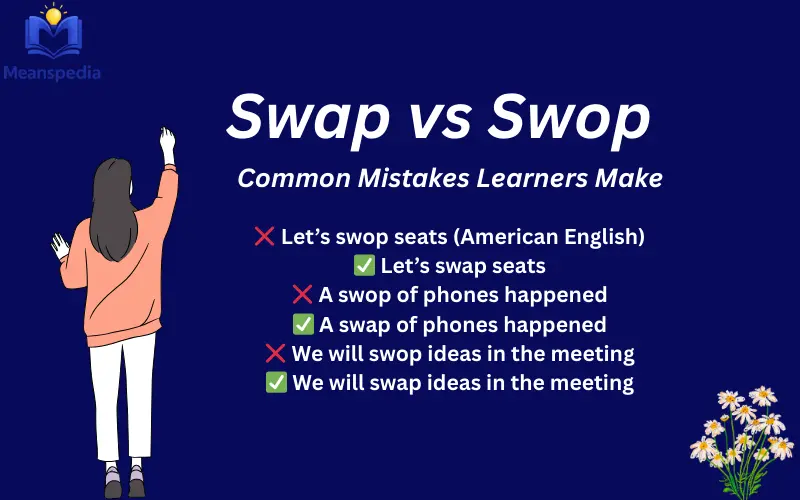
❌ Let’s swop seats (American English)
✅ Let’s swap seats
❌ A swop of phones happened
✅ A swap of phones happened
❌ We will swop ideas in the meeting
✅ We will swap ideas in the meeting
Very Simple Rule for Beginners
👉 Always use “swap.”
👉 Ignore “swop” in daily English.
This rule works in:
- speaking
- writing
- exams
- professional communication
Practice Exercises (Extended)
Choose the correct word:
- Let’s ___ seats. → swap
- They ___ gifts yesterday. → swapped
- Can we ___ phones? → swap
- It was a fair ___. → swap
- Workers can ___ shifts. → swap
- The companies agreed to ___ assets. → swap
Why Learning Swap vs Swop Is Important
Understanding swap vs swop helps learners:
- use modern English
- avoid rare or outdated words
- write clearly
- speak confidently
- improve vocabulary accuracy
See Also: Felt or Feel Simple Difference Explained With Easy Examples
Conclusion
The difference between swap and swop is not about meaning but about usage and modern preference. Both words mean to exchange one thing for another, but swap is the common, modern, and globally accepted word. Swop is rare, mostly British, and not recommended for everyday English.
For clear, natural, and correct English, learners should always choose swap. Understanding this difference improves communication, writing quality, and confidence in using English correctly.