
Many English learners feel confused when they see the spellings gluing vs glueing. Both words come from the verb glue, both seem logical, and both appear to follow English spelling patterns. Because of this, learners often believe that both spellings are correct or that one belongs to British English and the other to American English.
This confusion increases because English spelling rules are not always obvious. Some verbs keep their final letter when adding -ing, while others drop it. When learners see words like seeing, agreeing, and dying, they try to apply the same logic to glue, which creates doubt between gluing vs glueing.
This article explains gluing vs glueing in very simple English. It covers spelling rules, grammar logic, pronunciation, real-life usage, tense forms, gerunds, common mistakes, exam rules, British and American English differences, history of spelling, and practical examples. By the end of this guide, you will clearly know which spelling is correct and why.
Understanding the Word “Glue”
To understand gluing vs glueing, we must first understand the word glue itself.
Meaning of “Glue”
The word glue means:
- a sticky substance used to join things
- the action of sticking two or more things together
Glue as a Noun
- This glue is very strong.
- I need glue for this project.
Glue as a Verb
- I glue the paper to the wall.
- She glued the broken toy.
Verb Forms of “Glue”
Like all regular verbs, glue changes form.
| Verb Form | Example |
| Base form | glue |
| Third person | glues |
| Past tense | glued |
| Past participle | glued |
| -ing form | gluing |
The confusion only appears in the -ing form.
What Is the “-ing” Form Used For?
The -ing form of a verb is used for:
- continuous tenses
- gerunds (verb as noun)
- participles
Examples
- I am gluing the pieces.
- Gluing takes time.
- The gluing process is slow.
What Does “Gluing” Mean?
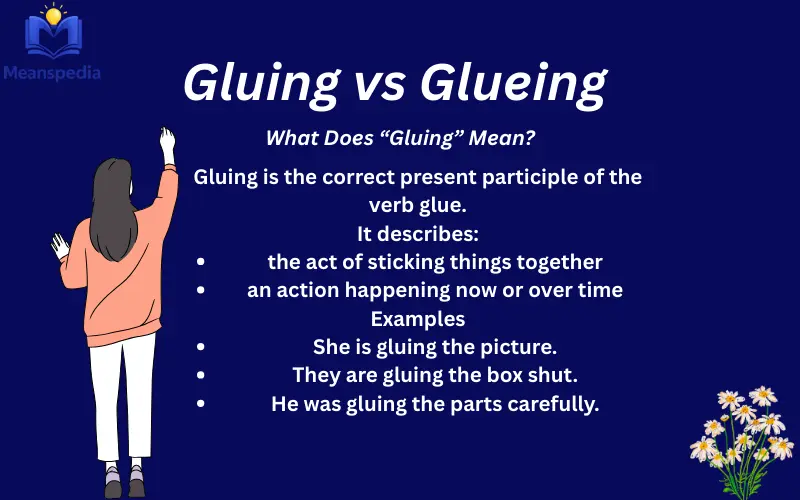
Gluing is the correct present participle of the verb glue.
It describes:
- the act of sticking things together
- an action happening now or over time
Examples
- She is gluing the picture.
- They are gluing the box shut.
- He was gluing the parts carefully.
What Does “Glueing” Mean?
Glueing looks like it should be correct because:
- the base word ends in e
- learners think the e should stay
However, glueing is not the standard or correct spelling in modern English.
See Also: Mine As Well or Might As Well Which One Is Correct?
Main Difference Between Gluing vs Glueing
| Feature | Gluing | Glueing |
| Correct spelling | ✅ Yes | ❌ No |
| Standard English | ✅ Yes | ❌ No |
| Accepted in exams | ✅ Yes | ❌ No |
| Modern usage | ✅ Common | ❌ Rare |
| Recommended form | ✅ Always | ❌ Never |
👉 Gluing is the correct spelling.
The Silent “E” Rule in English
The most important rule behind gluing vs glueing is the silent “e” rule.
The Rule
When a verb ends in a silent “e”, drop the e before adding -ing.
Examples
- make → making
- take → taking
- write → writing
- use → using
- glue → gluing
This rule is very strong and applies to most verbs.
Why the “E” Is Dropped
The silent e is dropped to:
- keep spelling consistent
- avoid unnecessary letters
- maintain pronunciation
In glue, the e does not affect pronunciation, so it is removed.
Why “Glueing” Looks Confusing to Learners
Learners often think:
- “glue” already ends in ue
- removing e looks strange
- pronunciation stays the same
But English spelling follows rules, not appearance.
Comparison With Similar Words
| Verb | Correct -ing Form |
| make | making |
| bake | baking |
| write | writing |
| glue | gluing |
| argue | arguing |
| use | using |
This pattern shows that gluing fits perfectly into English spelling rules.
Is “Glueing” Ever Correct?
In modern standard English:
- glueing is considered incorrect
- it is not recommended in writing
- it is marked wrong in exams
Some very old dictionaries or rare texts may show glueing, but:
- it is outdated
- not accepted today
- not taught to learners
Gluing in Present Continuous Tense
Structure
am / is / are + gluing
Examples
- I am gluing the pieces together.
- She is gluing the paper.
- They are gluing the model.
Gluing in Past Continuous Tense
Examples
- I was gluing the parts when he arrived.
- She was gluing the frame.
- They were gluing the project all night.
Gluing in Future Continuous Tense
Examples
- I will be gluing the poster tomorrow.
- She will be gluing the labels later.
Gluing as a Gerund (Verb Used as a Noun)
Examples
- Gluing requires patience.
- Gluing is part of the process.
- Gluing can be messy.
Gluing in Passive Voice
Examples
- The pieces are being glued together.
- The box was glued shut.
(Note: Passive uses glued, not gluing.)
Common Mistakes Learners Make
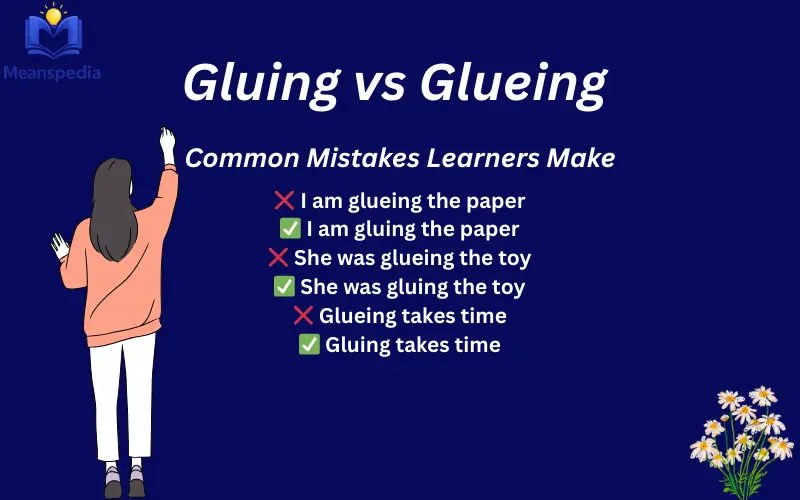
❌ I am glueing the paper
✅ I am gluing the paper
❌ She was glueing the toy
✅ She was gluing the toy
❌ Glueing takes time
✅ Gluing takes time
Gluing vs Glueing in British and American English
Some learners think:
- one spelling is British
- the other is American
This is not true.
Both UK and US English
- accept gluing
- reject glueing
There is no difference here.
Why Correct Spelling Matters
Correct spelling:
- improves writing quality
- avoids exam mistakes
- builds confidence
- looks professional
Wrong spelling like glueing:
- confuses readers
- reduces clarity
- looks incorrect
Gluing vs Glueing in Exams
In spelling and grammar tests:
- gluing = correct
- glueing = wrong
Always choose gluing.
Easy Memory Trick
👉 Drop the silent “e” before -ing
👉 glue → gluing
If you remember this rule, you will never confuse gluing vs glueing again.
Real-Life Examples of Gluing
At Home
- I am gluing the broken plate.
At School
- Students are gluing pictures in their books.
At Work
- He is gluing the package securely.
Why Learners Often Make This Mistake
Learners:
- overthink spelling
- trust sound instead of rules
- apply wrong patterns
Clear rules remove confusion.
Practice Exercises
Choose the correct spelling:
- She is ___ the photo to the wall.
a) glueing
b) gluing ✅ - ___ takes patience and care.
a) Glueing
b) Gluing ✅ - They were ___ the model together.
a) glueing
b) gluing ✅
See Also: If He Was or If He Were Which One Is Correct?
Conclusion
The difference between gluing vs glueing is based on a simple spelling rule. Gluing is the correct present participle of glue, while glueing is not accepted in standard modern English. The silent e in glue is dropped before adding -ing, just like many other English verbs.
By understanding this rule and practicing correct usage, learners can avoid spelling mistakes and write with confidence. Knowing the correct form of gluing vs glueing helps improve spelling accuracy, exam performance, and overall English writing skills.