
Many English learners feel confused when they see the words its vs it’s in sentences. These two words look almost the same, and they sound exactly the same when spoken. Because the difference is only an apostrophe, learners often think it is not important or that both words mean the same thing.
The confusion between its vs it’s is one of the most common grammar mistakes in English. Even advanced learners and native speakers sometimes use the wrong form while writing quickly. This mistake happens because apostrophes in English do not always work the way learners expect them to.
This article explains its vs it’s in very simple English. Every rule is explained step by step with clear meanings, easy examples, grammar logic, common mistakes, and practice exercises. By the end of this article, you will fully understand the difference between its and it’s, and you will be able to use both forms correctly and confidently.
Understanding the Pronoun “It”
Before learning its vs it’s, we must first understand the word it.
It is a pronoun.
It is used for:
- objects
- animals (when gender is unknown)
- ideas
- situations
- weather and time
Examples
- It is raining.
- It is my bag.
- The dog is sleeping because it is tired.
- It is late now.
The word it does not change for gender, and it is very common in English. From it, we get its and it’s, but they are used in very different ways.
What Does “It’s” Mean?
It’s is a contraction.
A contraction is a short form of two words.
👉 It’s = it is
👉 It’s = it has (in some cases)
This is the most important rule to remember.
“It’s” as “It Is”
Most of the time, it’s means it is.
Examples
- It’s cold today.
→ It is cold today. - It’s a good idea.
→ It is a good idea. - It’s important to study daily.
→ It is important to study daily.
If you can replace it’s with it is, then it’s is correct.
“It’s” as “It Has”
Sometimes it’s also means it has. This usually happens when has is followed by a past participle.
Examples
- It’s been a long day.
→ It has been a long day. - It’s stopped raining.
→ It has stopped raining. - It’s finished already.
→ It has finished already.
If it has makes sense, then it’s is correct.
See Aslo: Advice vs Advise Simple Grammar Difference Explained Clearly
Grammar Structure of “It’s”
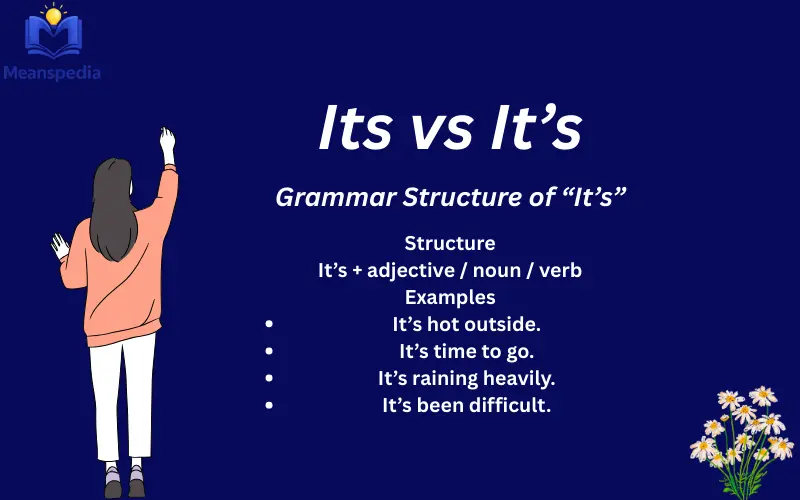
Structure
It’s + adjective / noun / verb
Examples
- It’s hot outside.
- It’s time to go.
- It’s raining heavily.
- It’s been difficult.
What Does “Its” Mean?
Its is a possessive adjective.
👉 Its shows ownership or belonging
It answers the question:
👉 Whose?
Examples of “Its”
- The dog wagged its tail.
- The company changed its logo.
- The phone lost its charger.
- Every country has its own rules.
In all these sentences, its shows that something belongs to it.
Grammar Structure of “Its”
Structure
Its + noun
Examples
- Its color is blue.
- Its price is high.
- Its purpose is clear.
Main Difference Between Its vs It’s
| Point | Its | It’s |
| Type | Possessive adjective | Contraction |
| Meaning | Belonging to it | It is / It has |
| Apostrophe | ❌ No | ✅ Yes |
| Used for | Ownership | Description or action |
| Example | its tail | it’s raining |
Very Easy Memory Trick
👉 If you can say “it is” → use it’s
👉 If you can say “belonging to it” → use its
This simple test works almost every time.
Why “Its” Has No Apostrophe
Many learners think its should have an apostrophe because it shows possession. But in English grammar:
- his
- her
- its
- their
None of these possessive adjectives use an apostrophe.
Examples
- his book
- her bag
- its tail
- their house
So its is correct without an apostrophe.
Why “It’s” Has an Apostrophe
It’s has an apostrophe because:
- letters are missing
- it is a contraction
it is → it’s
it has → it’s
The apostrophe replaces the missing letter.
Common Mistakes Learners Make
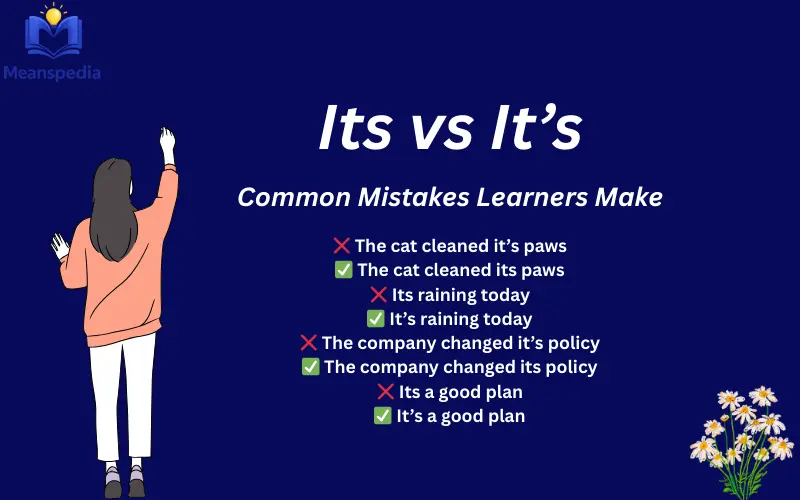
❌ The cat cleaned it’s paws
✅ The cat cleaned its paws
❌ Its raining today
✅ It’s raining today
❌ The company changed it’s policy
✅ The company changed its policy
❌ Its a good plan
✅ It’s a good plan
Its vs It’s in Questions
- It’s cold today, isn’t it?
- Is this its final decision?
Its vs It’s in Negative Sentences
- It’s not ready yet.
- The car lost its value.
Its vs It’s in Formal Writing
In formal writing:
- grammar accuracy is very important
- mistakes look unprofessional
Examples
- It’s important to follow the rules.
- The organization updated its policy.
Correct usage improves clarity and credibility.
Its vs It’s in Informal Writing
Even in informal writing:
- correct grammar improves understanding
- correct usage avoids confusion
Correct grammar is always a good habit.
Its vs It’s With Animals
When the gender is unknown, animals use its.
Examples
- The bird hurt its wing.
- The cat cleaned its fur.
Its vs It’s With Objects
Objects always use its.
Examples
- The laptop lost its battery.
- The tree lost its leaves.
Its vs It’s With Time and Weather
Time and weather usually use it’s.
Examples
- It’s late now.
- It’s hot today.
- It’s time to leave.
How to Check Your Sentence (Quick Test)
Ask yourself:
- Can I replace the word with it is or it has?
→ Yes → use it’s - Does the sentence show ownership?
→ Yes → use its
Why This Mistake Is So Common
This mistake happens because:
- both words sound the same
- the apostrophe is small
- English rules are confusing
But once you learn the rule, it becomes easy.
Its vs It’s in Exams
In exams:
- this mistake is very common
- wrong usage can reduce marks
Teachers expect:
- its for possession
- it’s for “it is” or “it has”
Practice Exercises
Choose the correct option:
- ___ raining outside.
→ It’s - The dog wagged ___ tail.
→ its - ___ a beautiful day.
→ It’s - The phone lost ___ charger.
→ its - ___ been a long day.
→ It’s
Why Learning Its vs It’s Is Important
Understanding its vs it’s helps learners:
- write correct English
- avoid common mistakes
- improve exam results
- sound professional
- communicate clearly
See Also: Swap vs Swop Meaning, Usage, Differences Explained Simply
Conclusion
The difference between its and it’s is small but very important. It’s is a contraction that means it is or it has, while its shows possession or belonging. Mixing them up is a common mistake, but it is easy to fix with simple rules and practice.
Once learners understand these rules and apply the quick test, using its vs it’s becomes natural. Correct usage improves writing quality and helps learners communicate clearly and confidently in English.