
Many English learners feel confused when they see the words advice vs advise. These two words look almost the same and sound very similar, which makes learners think they have the same meaning. Because of this confusion, people often use the wrong word in sentences, especially in writing, exams, and professional communication.
The confusion becomes stronger because advice and advise are used in similar situations. Both words are related to giving suggestions or guidance, but their grammar roles are different. One word is a noun, and the other is a verb. When learners do not understand this basic difference, they make common and repeated mistakes.
This article explains advice vs advise in very simple English. Every rule is explained step by step with clear meanings, grammar rules, pronunciation tips, many examples, real-life situations, common mistakes, and practice exercises. By the end of this guide, you will clearly understand when to use advice and when to use advise, and you will be able to use both words correctly and confidently.
The Core Difference Between Advice and Advise
The most important rule is very simple:
- Advice is a noun
- Advise is a verb
This one rule solves most confusion.
A noun is a thing, idea, or concept.
A verb is an action or something someone does.
See Also: Swap vs Swop Meaning, Usage, Differences Explained Simply
What Does “Advice” Mean?
Advice means:
- a suggestion
- guidance
- an opinion given to help someone
It is something you give, receive, or follow.
Simple Examples
- She gave me good advice.
- I need your advice.
- His advice helped me.
- Can you give me some advice?
In all these sentences, advice is a thing, not an action.
Grammar Rules for “Advice”
Advice Is Always a Noun
Because advice is a noun:
- it cannot show action
- it cannot be used as a verb
❌ She advice me
✅ She gives me advice
Advice Is an Uncountable Noun
A very important rule is:
👉 Advice is uncountable
This means:
- you cannot say an advice
- you cannot say advices
Correct Forms
- some advice
- a piece of advice
- helpful advice
- useful advice
Examples
- He gave me some advice.
- She shared a piece of advice.
- I received good advice.
- This is useful advice.
Why “Advice” Is Uncountable
In English, some nouns are treated like:
- information
- furniture
- knowledge
These nouns:
- do not have plural forms
- use quantity words instead
Advice works the same way.
Common Mistakes With “Advice”
❌ an advice
❌ advices
❌ she advice me
✅ some advice
✅ a piece of advice
✅ she gives me advice
What Does “Advise” Mean?
Advise means:
- to give advice
- to suggest something
- to guide someone
It is an action word, so it is a verb.
Simple Examples
- I advise you to study.
- The doctor advised rest.
- She advises students every day.
- They are advising the team.
Grammar Rules for “Advise”
Because advise is a verb:
- it shows action
- it changes with tense
- it can be used in different verb forms
Verb Forms of Advise
- advise (base)
- advises (present)
- advised (past)
- advising (continuous)
Examples
- I advise you to wait.
- He advises me often.
- She advised him yesterday.
- They are advising customers.
Advice vs Advise: Side-by-Side Comparison
| Feature | Advice | Advise |
| Part of speech | Noun | Verb |
| Shows action | ❌ No | ✅ Yes |
| Countable | ❌ No | — |
| Used with | give / get | to + verb |
| Example | good advice | advise someone |
How to Use “Advice” Correctly
Common Sentence Patterns
- give advice
- ask for advice
- get advice
- follow advice
- need advice
Examples
- She gave me advice.
- I asked for his advice.
- You should follow my advice.
- He needs some advice.
How to Use “Advise” Correctly
Common Sentence Patterns
- advise someone
- advise someone to do something
Examples
- I advise you to be careful.
- The teacher advised students to revise.
- She advises him to work harder.
Advice vs Advise in One Situation
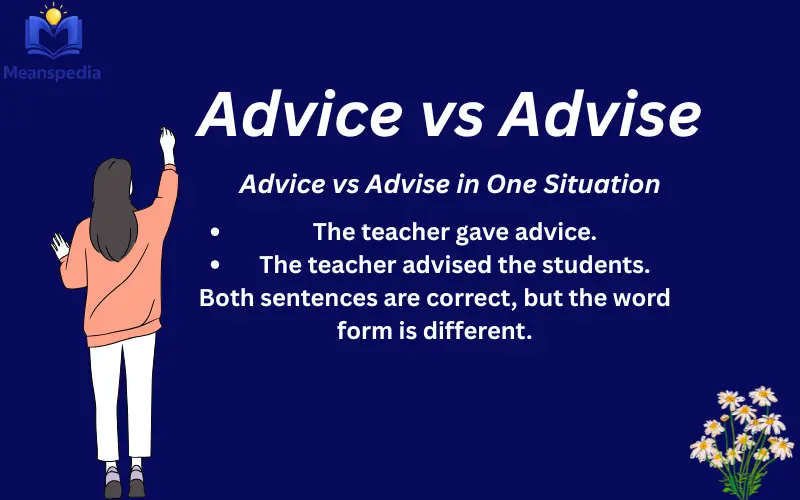
- The teacher gave advice.
- The teacher advised the students.
Both sentences are correct, but the word form is different.
Pronunciation Difference Between Advice and Advise
Pronunciation helps many learners remember the difference.
- Advice → ends with an /s/ sound (like ice)
- Advise → ends with a /z/ sound (like eyes)
Easy Memory Tip
- Sounds like ice → advice (noun)
- Sounds like eyes → advise (verb)
Advice vs Advise in Formal English
Formal Writing Examples
- I would like to seek your advice.
- We advise all users to follow instructions.
- Legal advice is important.
- We strongly advise caution.
Advice vs Advise in Informal English
Informal Speech Examples
- Can I get some advice?
- I advise you to try again.
The grammar rules stay the same.
Advice vs Advise in Questions
- Can you give me some advice?
- What do you advise me to do?
Advice vs Advise in Negative Sentences
- I did not follow his advice.
- I would not advise that decision.
Advice vs Advise in Different Tenses
Advise in Past
- He advised me yesterday.
Advise in Future
- I will advise you later.
Advice in All Tenses
- Her advice was helpful.
- His advice is useful.
- Their advice will help.
Common Learner Mistakes
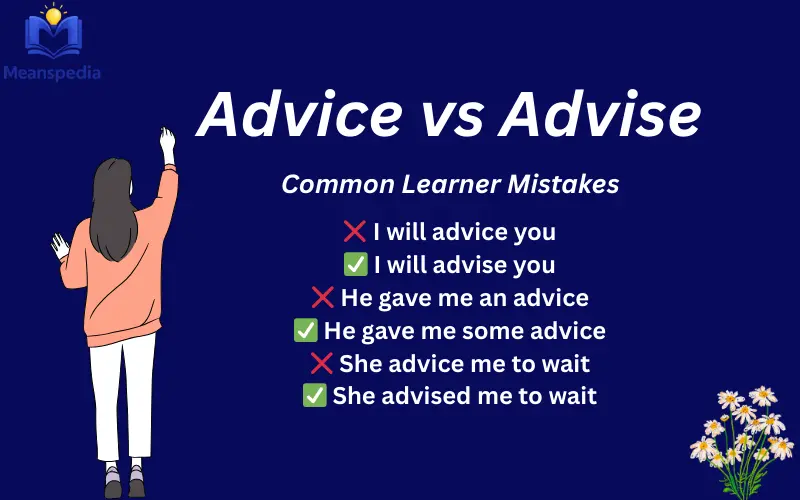
❌ I will advice you
✅ I will advise you
❌ He gave me an advice
✅ He gave me some advice
❌ She advice me to wait
✅ She advised me to wait
Very Simple Rule for Beginners
- If it is a thing → use advice
- If it is an action → use advise
Advice vs Advise in Real-Life Situations
School
- The teacher’s advice helped me.
- The teacher advised me to study.
Work
- He asked for career advice.
- The manager advised the team.
Health
- The doctor’s advice was clear.
- The doctor advised rest.
Why This Difference Matters
Using advice vs advise correctly helps learners:
- avoid grammar mistakes
- write better English
- sound professional
- perform well in exams
- communicate clearly
Practice Exercises
Choose the correct word:
- She gave me good ___ → advice
- I ___ you to be careful → advise
- He asked for legal ___ → advice
- The teacher ___ us to study → advised
- This is helpful ___ → advice
- I would ___ against that → advise
- His ___ was useful → advice
See Also: Persue or Pursue Correct Spelling and Easy Meaning
Conclusion
The difference between advice and advise is simple but very important. Advice is a noun that refers to a suggestion or guidance, while advise is a verb that means to give advice. Remembering this basic difference helps learners avoid many common English mistakes.
With clear understanding and practice, using advice vs advise becomes natural and easy. Correct usage improves both written and spoken English and helps learners communicate confidently and correctly.